

 English
  中文简体
中文简体 

4515Q
4515Q A91 3222 S1293 American Brake Shoes is a premium, high-performance replacement component meticulously engineered for use in heavy-duty braking s...
See Details
Content
If you have ever stood at a parts counter trying to pick a replacement lining, you know the feeling: several boxes, similar-looking blocks, very different prices, and no obvious way to tell what the brake lining material inside them will actually do once it is on the road. We have been building heavy-duty brake shoes and linings for more than twenty years, and that question still comes up in nearly every conversation we have with fleets, repair shops and distributors.
So here is a plain-language walk-through: what brake lining material is made of, how the main families differ, and how to match a friction mix to the work a truck actually does.
A brake lining is a composite. Nobody mines it in one piece. It is engineered from four groups of ingredients that are blended, pressed into shape and then cured under heat and pressure until the resin sets and the block hardens into something that can turn motion into heat thousands of times without coming apart.
Change the ratio and you change everything: cold bite, hot friction, wear rate, noise, dust, even how kind the lining is to the drum or rotor. All of that comes out of the recipe, not out of the shape of the block.
Most linings sold for trucks and trailers fall into one of a handful of families. The table below is the version we use when we talk a customer through the trade-offs.
| Material family | Typical make-up | Friction and heat behaviour | Where it fits best |
|---|---|---|---|
| Non-asbestos organic (NAO) | Phenolic resin with aramid, glass and mineral fibres; high filler content | Smooth and quiet, but friction falls away noticeably once the drum gets very hot | Light trucks, buses, delivery and stop-start urban work |
| Semi-metallic | Roughly 30 to 65 percent steel wool or iron powder with graphite and resin | Stable when hot, good fade resistance, a little more aggressive on the drum | Line-haul tractors and mixed regional duty |
| Ceramic and ceramic-enhanced | Ceramic fibres, low or zero copper formulations, minimal steel content | Flat friction curve across a wide temperature range, less dust and noise | Premium aftermarket where a predictable pedal matters |
| Sintered or full metallic | Metal powders such as copper and iron, sintered under high pressure and temperature | Very high temperature capability, noisier, harder on drums and rotors | Refuse, mining, logging and long mountain descents |
| Carbon composite | Carbon fibre held in a carbon matrix | Extremely stable friction at extreme temperatures, very expensive | Aerospace and motorsport rather than everyday fleets |
None of these is better in the abstract. A full metallic lining that lasts beautifully in a quarry will drive a long-haul driver crazy with noise and eat his drums for breakfast. A soft organic lining that feels wonderful in city traffic can fade on the first serious mountain grade.
Friction material is only half of the equation. The other half is the duty cycle it lives in. A lining that runs at 180 degrees Celsius all day on flat interstate will behave very differently on the same axle when the truck is loaded to gross weight and working a two-lane mountain road, where drum temperatures can climb past 400 degrees Celsius in a single descent.
Axle load, drum versus disc, ambient temperature, trailer configuration, driver technique and even how well the shoes were bedded in during the first few hundred kilometres all shift the result. That is why we always ask about the route and the load before recommending a friction level, rather than simply quoting the cheapest block in the size the customer asked for.
Both families do the same job, but they were developed around different vehicles and different habits. American heavy-truck linings tend to be thick blocks, often riveted or bonded to a heavy shoe, sized for large drums and long, steady highway pulls. European linings are frequently thinner, more tightly toleranced, and formulated for higher average speeds, more frequent braking and, in many cases, disc brakes on the front axle.
Dimension is only part of it. Rivet patterns, block length, chamfer and the friction level written on the edge code all have to line up with the shoe and the drum they are going onto. If you want the longer version of that comparison, we covered it in our industry notes on American and European brake linings.
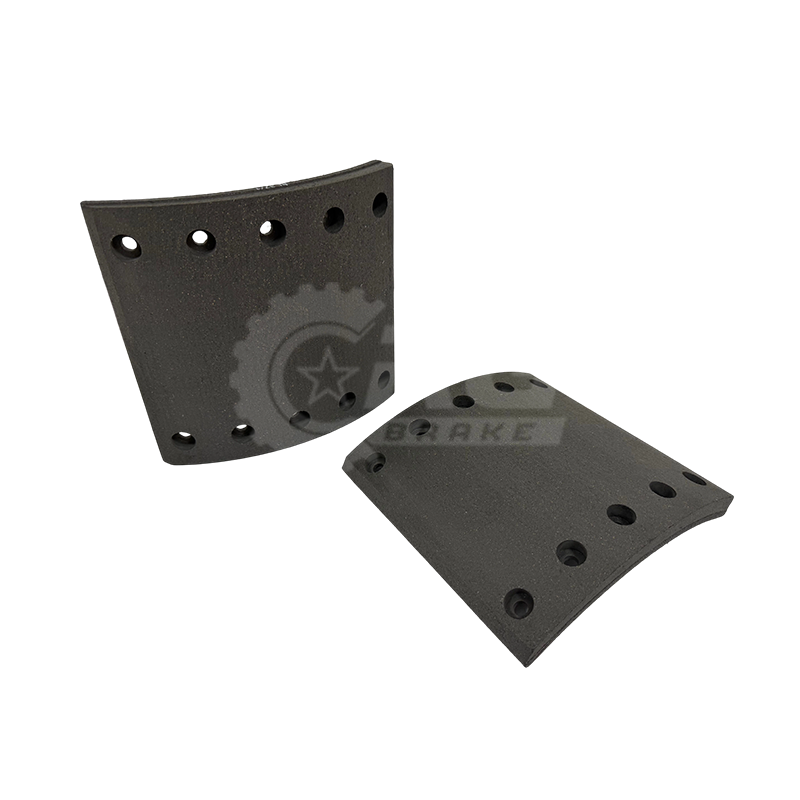 19032 European Brake Lining for BPW SystemsBPW brake lining with WVA 19032 and FMSI BPW180 references, 420 mm by 180 mm, relevant to friction edge-code selection.View Product →
Most linings carry a two-letter friction code stamped on the edge, based on the SAE J866 scale. The first letter describes friction when the block is cold, the second when it is hot. F sits in the 0.35 to 0.45 band, G in the 0.45 to 0.55 band, and H above that. So an FF lining is consistent from cold to hot, while a GH lining bites a little harder when warm.
An edge code such as 23K FF on one of our data sheets is simply a shorthand for the formulation and the friction band it was tested to. Treat the code as a starting point, not a verdict: it tells you the friction level, not how fast the lining will wear, how much dust it makes or how well it recovers after a long hard descent.
When a customer sends us a fleet profile, this is roughly how we narrow the choice:
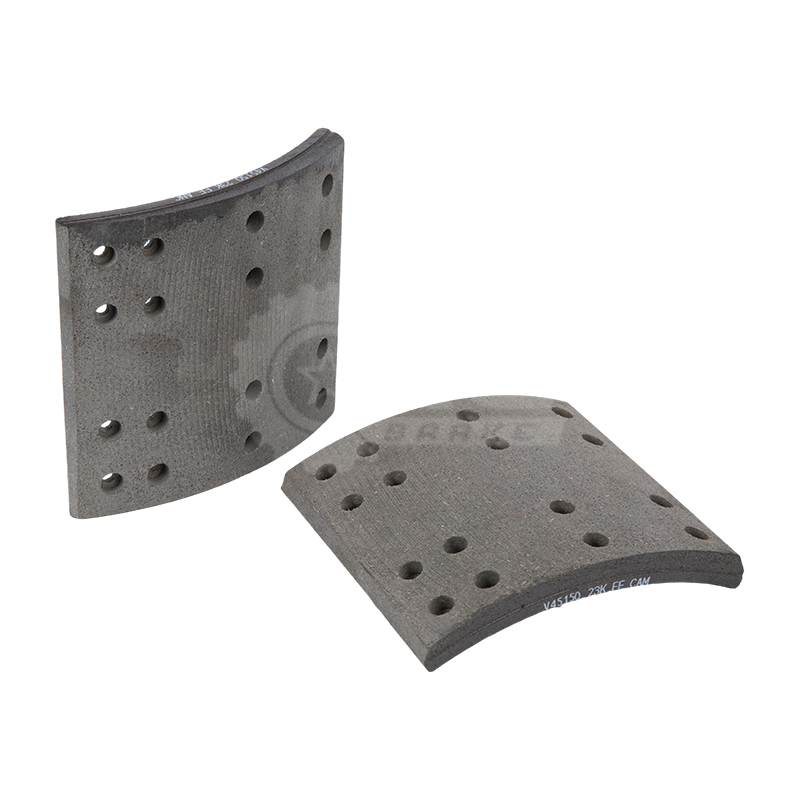 4515 American Brake Linings for Meritor AxlesHeavy-duty 16.5 x 7 in lining with FMSI 4515 and WVA 19036/19037 references, suited to Meritor axle assemblies.View Product →
Mixing is only the beginning. Batch weight and mixing time have to be held to the recipe, pressing pressure and temperature have to be watched, and the cure has to be complete without scorching the surface. We check hardness, density and dimensions on the shop floor, and we run friction and wear testing in our own laboratory before a formulation goes into regular production.
Twenty-odd years of doing this has taught us that consistency matters more than any single number on a specification sheet. A lining that performs the same way in the first week and the fiftieth is worth more to a fleet than one that is brilliant on the test bench. If you would like to know more about how we work, there is a short introduction on our about page.
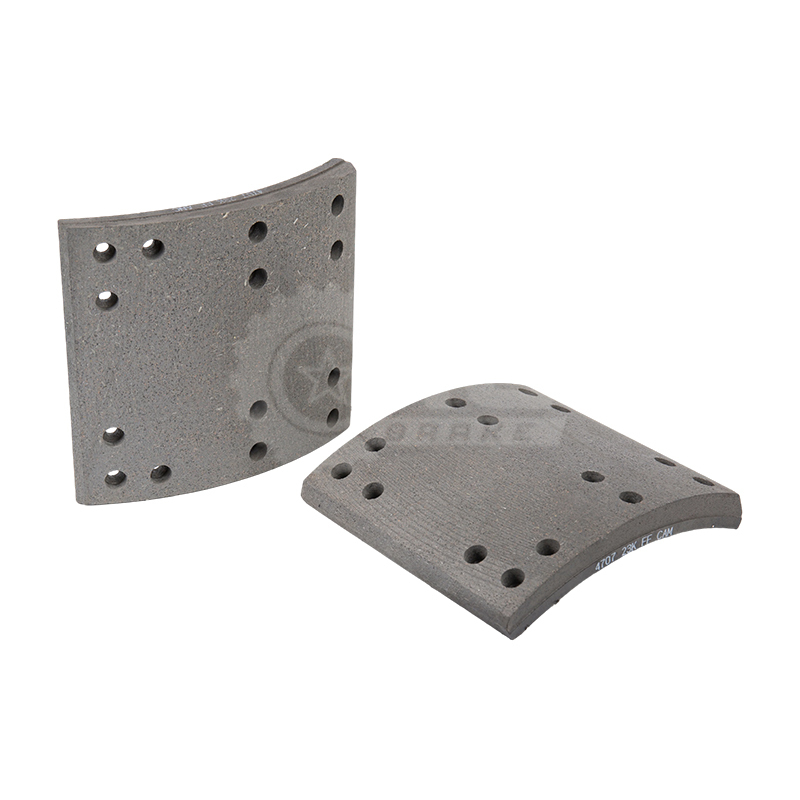 4707 American Brake Linings for Heavy-Duty VehiclesHeavy-duty 16.5 x 7 in lining with FMSI 4707 and WVA 19030 references, intended for Meritor axle systems and long-haul use.View Product →
Brake lining material is not really a commodity you can pick by price per block. It is a set of engineering trade-offs between stopping power, heat, wear, dust and the life of the drum it presses against. Understanding the recipe behind the block is what turns a parts purchase into a maintenance decision.
If you are working through a specific application, tell us the vehicle, the route and the load. We will happily talk through the friction level that fits, whether that leads to an order or not.
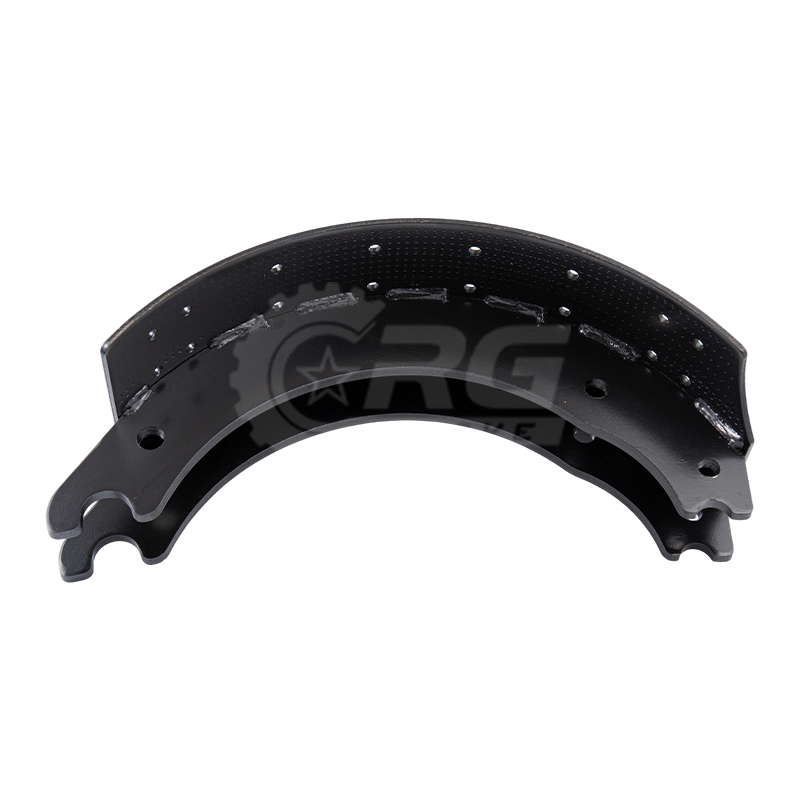
4515Q A91 3222 S1293 American Brake Shoes is a premium, high-performance replacement component meticulously engineered for use in heavy-duty braking s...
See Details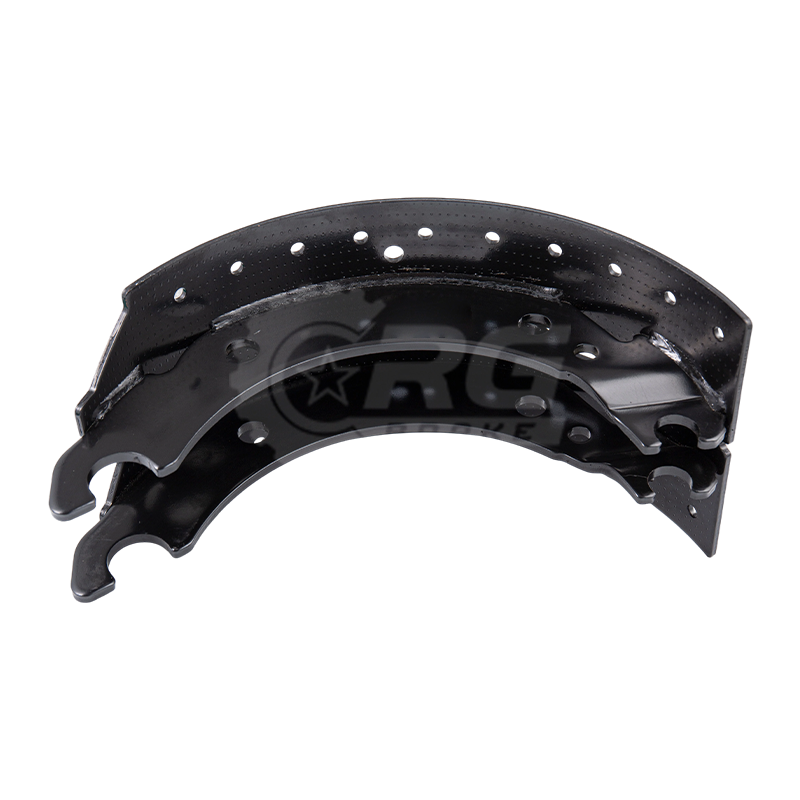
The BPW200 05.091.27.83.0 European Brake Shoes, with a size specification of 420×200mm, is a high-performance aftermarket replacement component that i...
See Details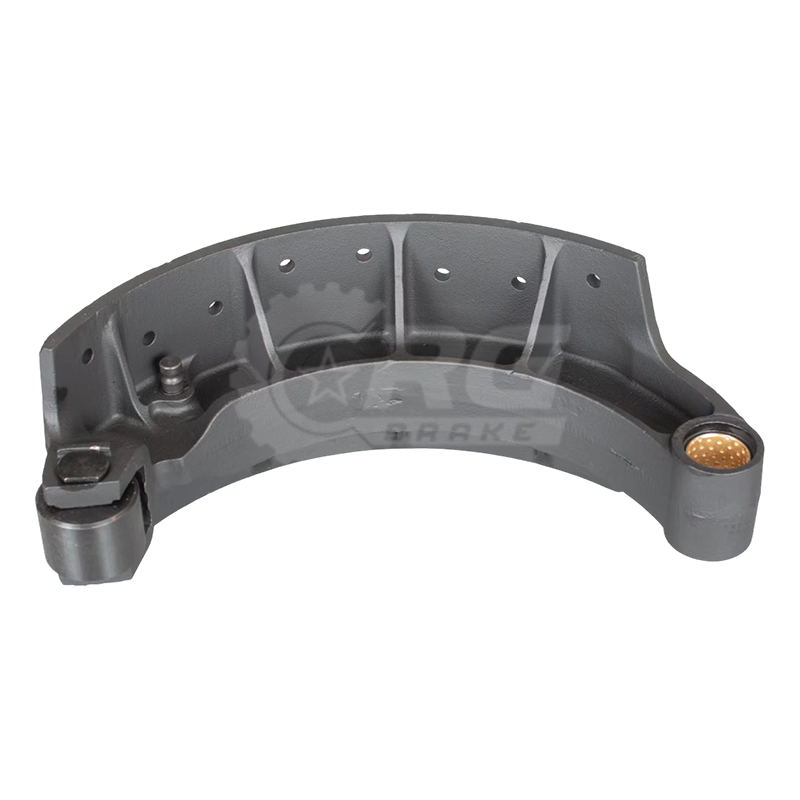
BENZ180 659 420 0619 Cast Brake Shoes, with precise dimensions of 410×180mm, is meticulously engineered to meet the rigorous demands of commercial and...
See Details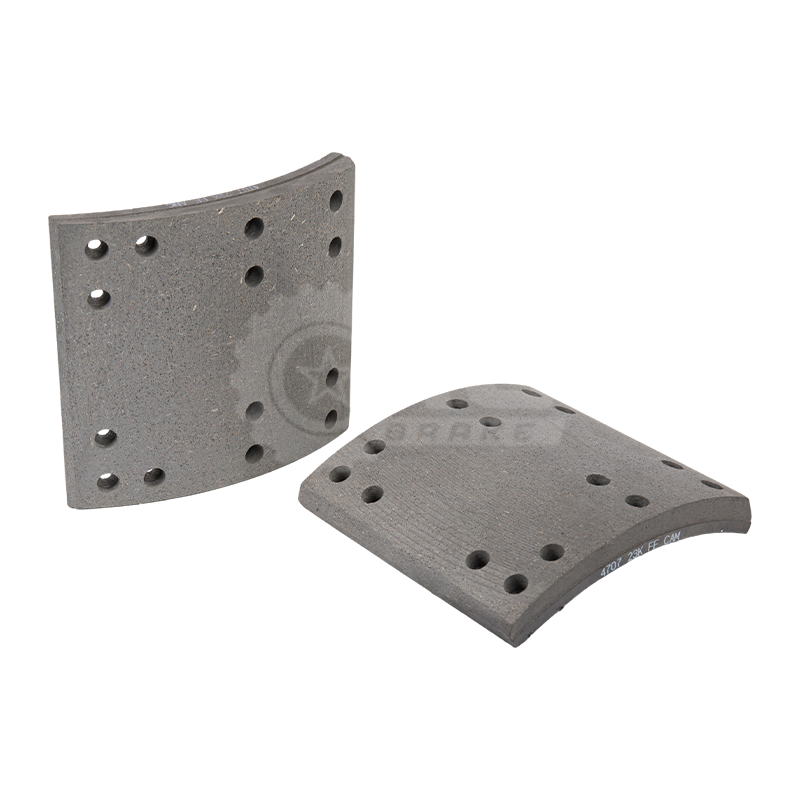
The 4707 American Brake Linings are engineered to deliver outstanding braking performance, specifically designed to handle the rigorous demands of hea...
See Details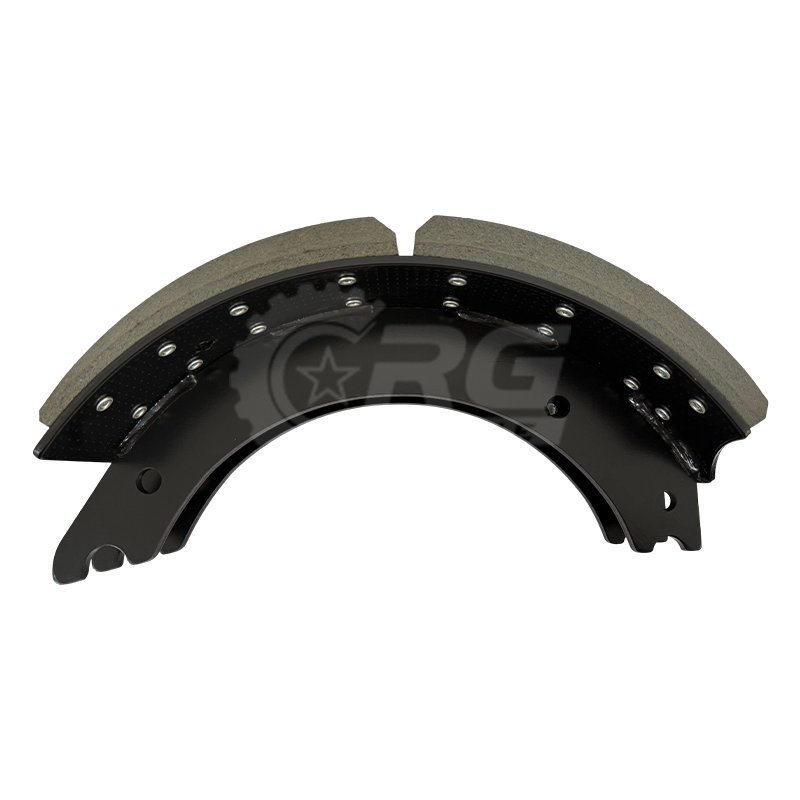
The 4718Q A3222 J2272 Lined Brake Shoes are meticulously engineered to offer exceptional durability and superior performance, specifically designed fo...
See Details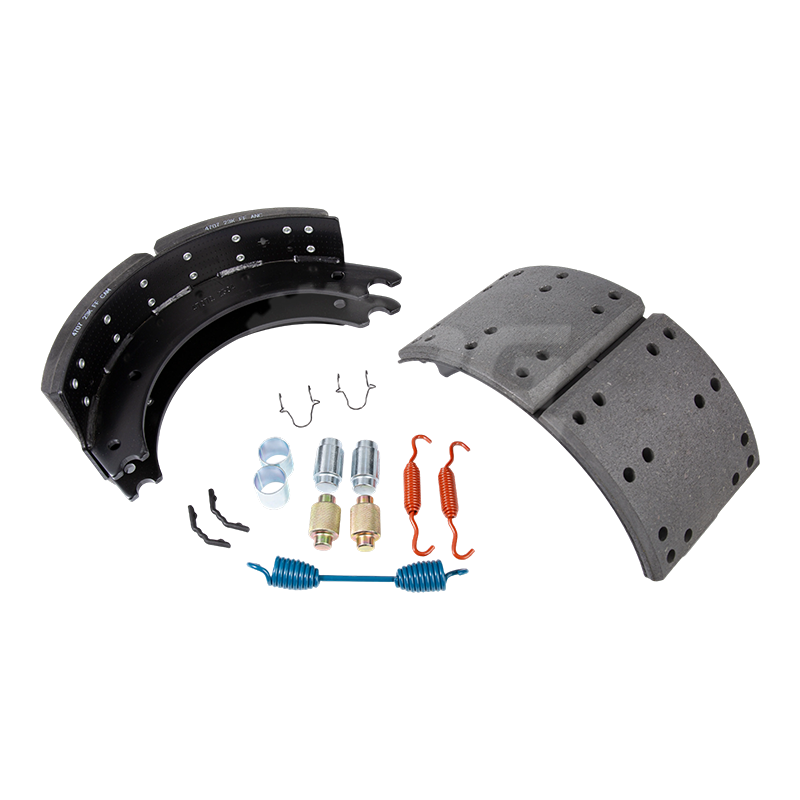
Our 4707Q A19 3222 D2006 Lined Brake Shoes With Hardware Kits are precision-engineered components measuring 16.5 inches in length and 7 inches in widt...
See Details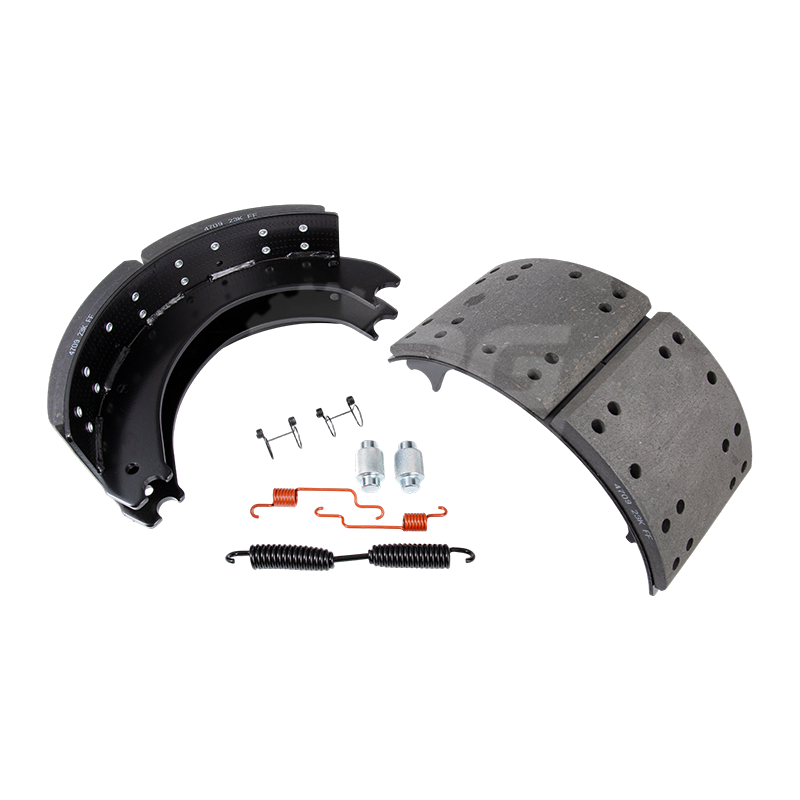
These 4709ES2 EATON 819707 Lined Brake Shoes With Hardware Kits measure 16.5 inches by 7 inches, specifically engineered to fit vehicles that require ...
See Details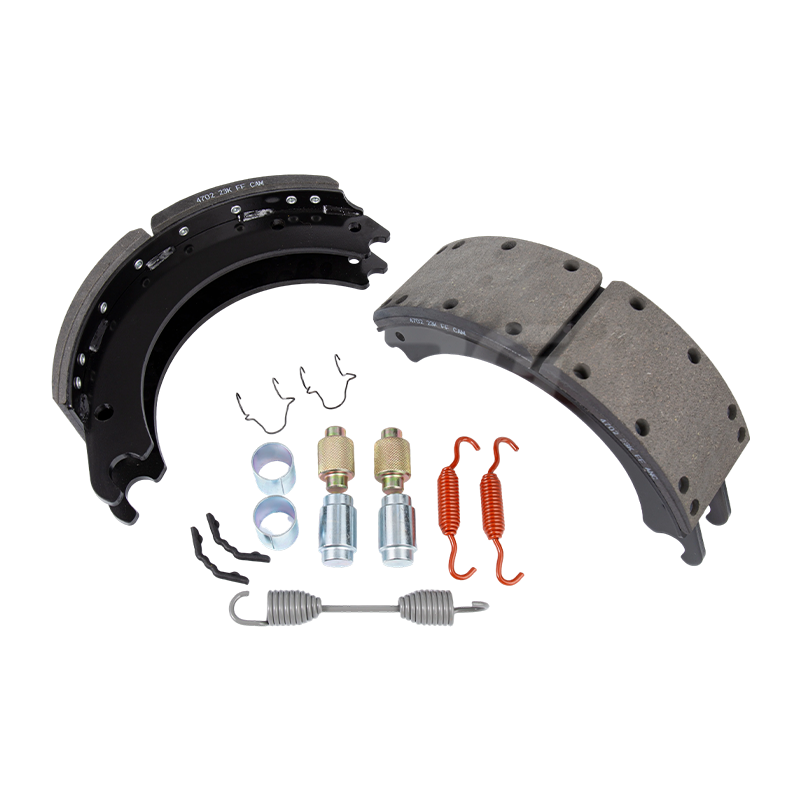
The 4702Q A3222 M2223 Lined Brake Shoes With Hardware Kits with Hardware Kits, measuring 15 inches by 4 inches, are meticulously engineered to provide...
See Details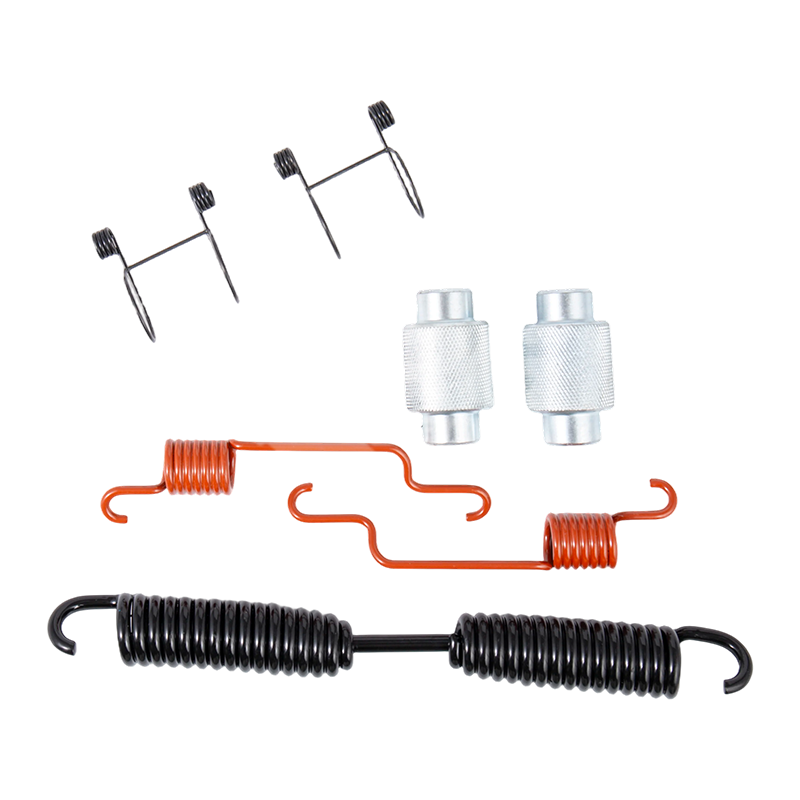
This hardware kit, model E-10244S with part number 4709ES2, is a premium-grade brake repair kit meticulously engineered for comprehensive vehicle brak...
See Details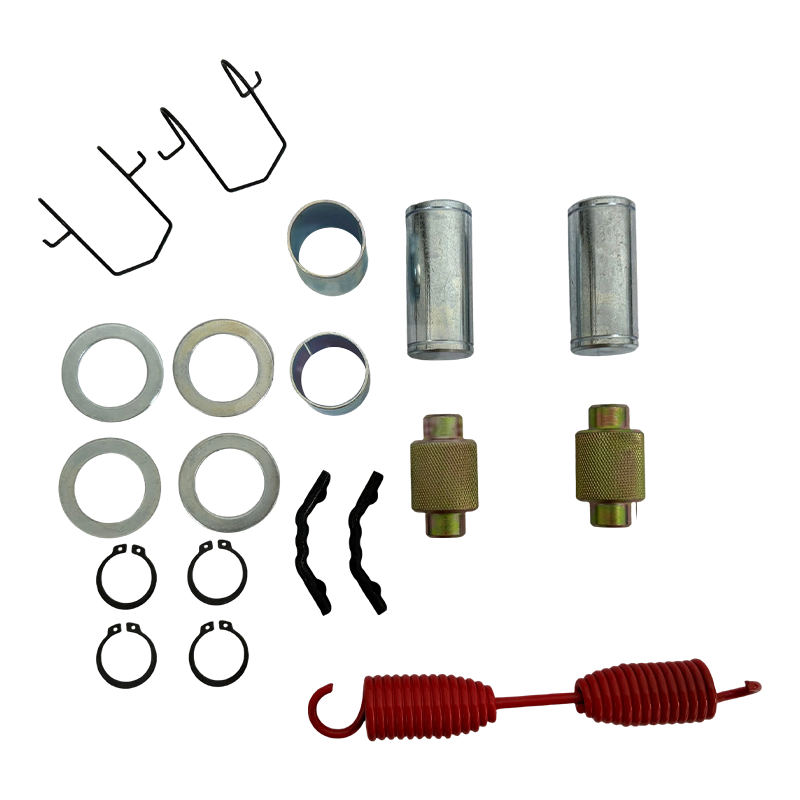
BPW NEW Brake Repair Kit represents a state-of-the-art, precision-engineered hardware solution specifically designed for the high-performance maintena...
See DetailsGet a Free (Customized) Quote

derek@crgbrake.com
vicky@crgbrake.com

 OUR Product
What’s News
Copyright © Zhejiang Courage Auto Parts Co., Ltd. All Rights
Reserved
 Commercial Vehicles CRG Brake Parts Manufacturers